

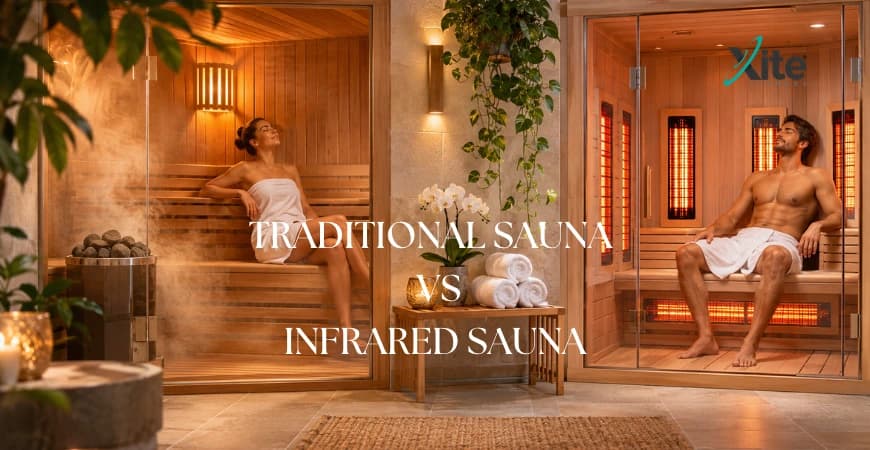

Are you designing a high-end luxury resort in Dubai? However, when planning your space, one major question comes up: Traditional Sauna vs Infrared Sauna—which one is better for your needs?
Of course, both of them come with the similar health benefits. But, they work differently on your body. In this simple guide, we break down the key differences between traditional and infrared sauna. That should help you choose the best option for your facility.
What Is a Traditional Sauna?
A traditional sauna is also called a Finnish sauna. It simply heats the air in the room this heat is then used to warm your body up.
The key features of a traditional sauna include
- Operating Temperature: Very high heat, usually between 75°C and 100°C to 70°C and 100°C.
- Heating Method: Uses an electric or wood-burning heater filled with hot sauna stones.
- Steam Feature: You can pour water over the hot stones to create bursts of hot steam.
- Experience: Provides an intense, hot, and classic sauna sweat session.
What Is an Infrared Sauna?
An infrared sauna uses special infrared light panels to heat your body directly. There is no need for extensive heating of the surrounding air.
Key features available on an infrared sauna include
- Operating Temperature: Lower, comfortable heat, usually between45°C and 60°C to 40°C and 60°C.
- Heating Method: Infrared light waves penetrate into your skin and muscles.
- Steam Feature: Dry heat only. Water cannot be poured inside.
- Experience: Offers a gentle, comfortable, and relaxing sweat session that is easy to sit in for a longer time.
Traditional vs Infrared Sauna: Key Differences
Here is a quick look at the differences between traditional and infrared sauna.
Feature | Traditional Sauna | Infrared Sauna |
How It Heats | Heats the air with hot stones | Heats your body directly with light panels |
Temperature | Very Hot (70°C–100°C) | Mild & Comfortable (40°C–60°C) |
Steam Option | Yes (pour water on stones) | No (dry heat only) |
Warm-up Time | 30 to 45 minutes | Under 10 minutes |
Energy Use | Higher energy consumption | Lower energy consumption |
Space Needed | Needs higher ceilings & multi-level benches | Fits easily into small or compact spaces |
Best For | Commercial gyms, luxury spas, traditional experience | Recovery centers, boutique studios, home wellness |
Traditional Sauna vs Infrared Sauna: Which Requires More Space?
Installing a sauna in a gym, hotel or a home? Space is perhaps one of the most important factors you need to consider.
Space requirements of a traditional sauna
Traditional saunas need higher ceilings because heat rises. Bathers sit on higher benches for maximum heat and lower benches for cooler temperatures. You should also provide a proper wall insulation and air gaps around the heater. The sauna needs a waterproof flooring to handle water and sweat.
Space requirements of an infrared sauna
Infrared saunas direct heat straight to the person. Thus, they do not require tiered seating or high ceilings. They come in compact, pre-made designs. Thus, they can easily fit into corners, small spare rooms, or boutique spaces.
Note –
Do you have limited space or standard ceiling height? An infrared sauna is easier to install. Do you have plenty of room and want to accommodate multiple people at once? A traditional sauna is ideal.
Which Sauna Is Better for Commercial Wellness Spaces?
The type of sauna you choose is dependent on the demand and type of business you conduct.
High-Traffic Gyms & Fitness Clubs
- Best Choice: Traditional Sauna
- Why: Traditional saunas are well-suited for larger groups and commercial use. A large traditional sauna room can accommodate 8 to 15 members at once and recover heat effectively between sessions.
Specialized Recovery & Biohacking Hubs
- Best Choice: Infrared Sauna
- Why: Modern athletic recovery hubs often sell private 30-minute recovery sessions. Infrared saunas are great for 1-on-1 sessions, fast warm-up cycles, and post-workout muscle recovery.
Traditional vs Infrared Sauna: Installation and Maintenance
The maintenance requirements of a traditional sauna differ considerably from an infrared sauna.
- Power requirements - Power Requirements – Traditional saunas need a powerful, dedicated electrical supply to operate their heaters, while infrared saunas generally run on standard power connections.
- Ventilation - Traditional saunas need proper air intake and exhaust vents. This is necessary to handle humidity and keep fresh air circulating. Infrared saunas only need basic air flow.
- Cleaning & Upkeep: Both saunas need regular cleaning with safe, non-toxic products. Traditional saunas also require checking stones periodically. The infrared panels need simple surface dusting.
Which Sauna Is More Suitable for Hotels and Spas?
Once again, the preferences will depend on multiple factors.
- Luxury Hotels & Spas: A traditional sauna provides a classic, high-end spa experience. Guests love the rich wood aroma. They also love the traditional ritual of pouring water on hot stones.
- In-Suite & Modern Guest Amenities: An infrared sauna is perfect for private guest suites or boutique VIP rooms. It offers a modern, dry-heat wellness option.
Traditional vs Infrared Sauna: Cost Considerations
The cost of infrared and traditional sauna depends on several factors.
- Size and Capacity: Larger rooms require bigger heaters and more materials.
- Materials & Finishes: You may choose to use high-grade timbers (like Cedar or Hemlock) and custom glass doors. However, they increase overall pricing.
- Electrical & Building Work: Custom wiring, ventilation, and room preparation.
- Running Costs: Infrared saunas warm up faster and use less electricity. It can lead to lower monthly power bills.
How Do You Choose the Right Sauna for Your Wellness Space?
We recommend asking a few questions before you choose a sauna for your property.
- What heat style do your users like? Intense steam heat (Traditional) or gentle direct heat (Infrared)?
- How much space do you have? High ceiling and large area (Traditional) or small/compact footprint (Infrared)?
- What is your electrical setup? Can your facility support heavy-duty power lines?
- How many people will use it at once? Large groups work best with traditional sauna. A private 1-on-1 sessions is the best with infrared sauna.
- What is your daily energy budget? Looking for lower monthly electricity bills (Infrared)?
Custom Sauna Solutions by Xite Fitness
Xite Fitness is a trusted supplier of gym and wellness equipment in Dubai and across the UAE. We provide complete design, supply, installation, and support for all types of sauna projects.
Why choose us?
- Full Design & Installation: We handle everything from space planning and design to final setup.
- Top Quality Brands: We work with world-class wellness equipment and reliable heating systems.
- Total Customization: Choose your preferred wood types, glass fronts, modern LED lighting, and layout designs.
- Complete Wellness Setup: Easily combine your sauna with steam rooms, cold plunge pools, and workout areas.
- Ongoing Maintenance & Support: We offer regular servicing, repairs, and support
Ready to design the perfect sauna for your space? Contact Xite Fitness today to get expert guidance and a customized quote for your project!